Supporting the Global Goals: How Collaboration Creates Lasting Humanitarian Impact
Supporting the Global Goals: How Collaboration Creates Lasting Humanitarian Impact
The world’s greatest challenges are not isolated. Hunger is connected to poverty. Education is connected to opportunity. Clean water is connected to health. Economic stability is connected to strong communities. Peace is connected to justice, safety, and access to resources.
That is why the 17 Sustainable Development Goals, also known as the Global Goals, matter. They give communities, organizations, governments, businesses, churches, universities, researchers, and everyday people a shared framework for creating a better future.
But goals do not create change by themselves.
People do.
Collaboration is what turns vision into action. It brings the right minds, resources, skills, and compassion together to address real needs and build solutions that last.
What Are the Global Goals?
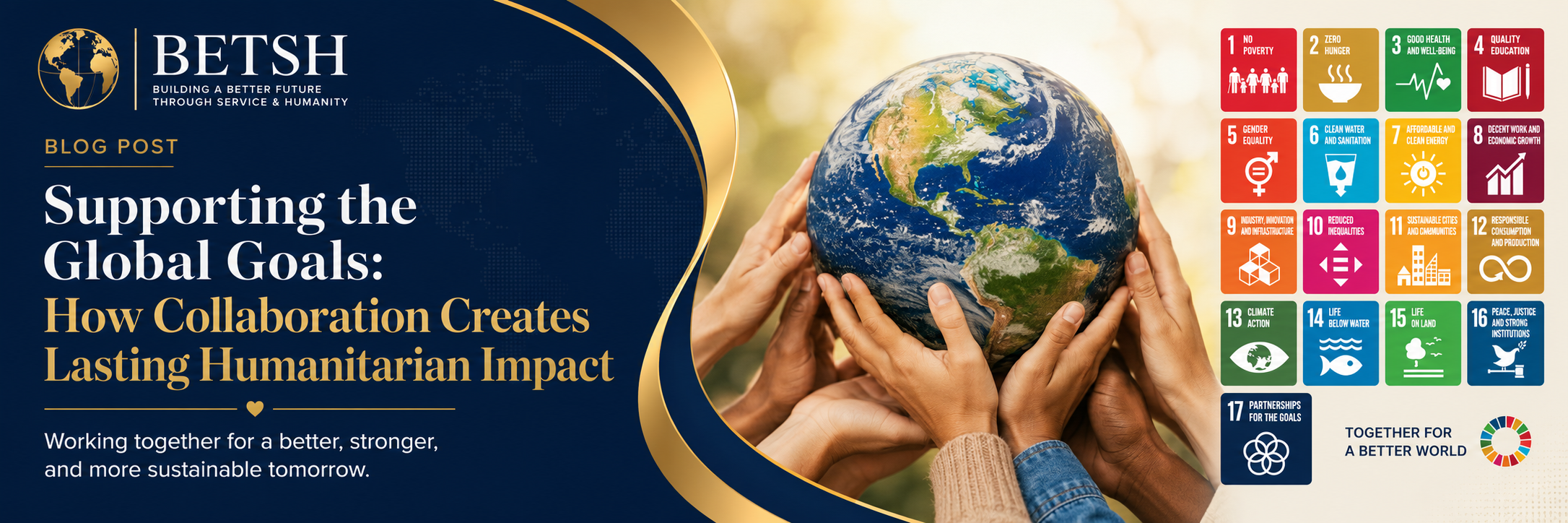
The 17 Sustainable Development Goals were created as a global call to action to address some of the most urgent issues affecting humanity and the planet.
These goals include ending poverty, reducing hunger, improving health, expanding education, protecting clean water, supporting economic opportunity, responding to climate challenges, strengthening communities, and building partnerships for long-term progress.
Each goal matters on its own, but the true strength of the Global Goals is how connected they are.
A community cannot fully address hunger without also thinking about income, education, agriculture, health, transportation, and local resources. A family cannot thrive without access to safe housing, clean water, healthcare, and opportunity. A nation cannot move forward without strong partnerships, peace, and sustainable systems.
The Global Goals remind us that lasting humanitarian impact requires a whole-community approach.
Why Collaboration Matters
No single organization can solve every problem. No single community has every resource. No single leader has every answer.
Collaboration allows people and organizations to work together toward a shared mission.
When organizations collaborate, they can:
Share knowledge and best practices
Reach more people
Reduce duplicated efforts
Respond faster to urgent needs
Build trust across communities
Create solutions that are more practical and sustainable
This kind of work is not about one group doing everything. It is about many people doing their part with purpose.
That is where long-term impact begins.
How Collaboration Creates Sustainable Change
Short-term support is important. A meal, a donation, a supply box, or an emergency response can meet an immediate need. But lasting impact requires more than temporary relief.
Sustainable change happens when communities are strengthened from the inside out.
That means helping people access resources, education, support systems, partnerships, and opportunities that continue to serve them over time.
For example:
Food programs can connect with local growers, schools, churches, and health organizations to improve nutrition and reduce hunger.
Education programs can partner with researchers, universities, and community leaders to create practical learning opportunities.
Health initiatives can work with service providers, volunteers, and nonprofits to improve access to care and wellness support.
Disaster response efforts can involve local governments, faith communities, emergency teams, and volunteers to prepare before crises happen.
Economic empowerment programs can connect businesses, mentors, workforce partners, and community organizations to expand opportunity.
Collaboration creates stronger systems. Stronger systems create stronger communities.
BETSH and the Mission of Collective Impact
Best Efforts to Save Humanity, Inc. is built around the belief that humanitarian progress requires shared effort.
BETSH works to identify, share, and implement practical solutions that help save lives and improve quality of life. That mission aligns closely with the Global Goals because both are focused on human dignity, community strength, sustainability, and meaningful action.
Through partnerships with individuals, churches, universities, nonprofits, businesses, researchers, and civil society organizations, BETSH helps bring people together around a common purpose.
The work is not limited to one issue or one location. It is about building a network of people and organizations committed to helping humanity through compassion, service, research, education, and collaboration.
The Power of Partnerships for the Goals
Goal 17, Partnerships for the Goals, is one of the most important parts of the Sustainable Development Goals.
Why?
Because partnership is what makes the other goals possible.
Ending hunger takes partnership. Improving education takes partnership. Expanding healthcare takes partnership. Responding to disasters takes partnership. Protecting the environment takes partnership. Building peaceful and resilient communities takes partnership.
Partnership connects the mission to the method.
It allows people to move from concern to contribution.
It helps transform good intentions into organized action.
How Communities Can Support the Global Goals
Supporting the Global Goals does not require waiting for a large organization or international program to lead the way. Communities can begin with the needs directly in front of them.
People can support the Global Goals by:
Volunteering with local service organizations
Supporting food access and hunger relief efforts
Donating goods, supplies, or professional services
Sharing educational resources
Supporting health and wellness initiatives
Helping communities prepare for emergencies
Partnering with organizations already doing the work
Advocating for vulnerable families and underserved communities
Creating programs that solve real problems locally
Every action matters when it is connected to a larger mission.
Small Actions Can Lead to Global Impact
Sometimes global change can feel too large to touch. But every major movement begins with individual people choosing to act.
A volunteer gives time.
A donor gives resources.
A teacher shares knowledge.
A business offers support.
A church opens its doors.
A researcher shares insight.
A community leader connects people.
A family chooses to serve.
Together, these actions create momentum.
The Global Goals give us the framework. Collaboration gives us the pathway. Compassion gives us the reason.
Moving Forward Together
The future depends on our willingness to work together.
Lasting humanitarian impact does not happen through isolated effort. It happens when people unite around shared responsibility, practical solutions, and a commitment to human dignity.
The Global Goals remind us what is possible. Collaboration helps make it real.
By working together, we can help save lives, improve quality of life, strengthen communities, and build a better future for generations to come.
Call to Action
BETSH invites individuals, organizations, churches, universities, businesses, researchers, and community leaders to join the mission.
Together, we can support the Global Goals and create lasting humanitarian impact.
Get involved. Become a partner. Share your expertise. Support the mission.
